
Updated: February 2026 | By [Investopedia Team]
Investing in an IPO can double your money in a single morning, or lock your capital away for months. The difference isn’t luck—it’s knowing which metrics actually matter.
The Quick Answer: To succeed in IPOs, ignore the marketing hype and track the Grey Market Premium (GMP). If the GMP is >30% and the company passes our “Red Flag Test,” apply via the sHNI category (₹2 Lakhs+) for higher allotment chances. Always verify your application status using our Master Allotment Guide.
Key Takeaways
- The Golden Rule: Never apply blindly; check the GMP and Subscription status first.
- The Strategy: Small HNI (sHNI) applications have a better success rate than Retail.
- The Risk: SME IPOs offer higher returns but come with liquidity risks.
- The Tool: Use official Registrar links to check allotment, not bank SMS.
Step 1: Understand the Game (Mainboard vs. SME)
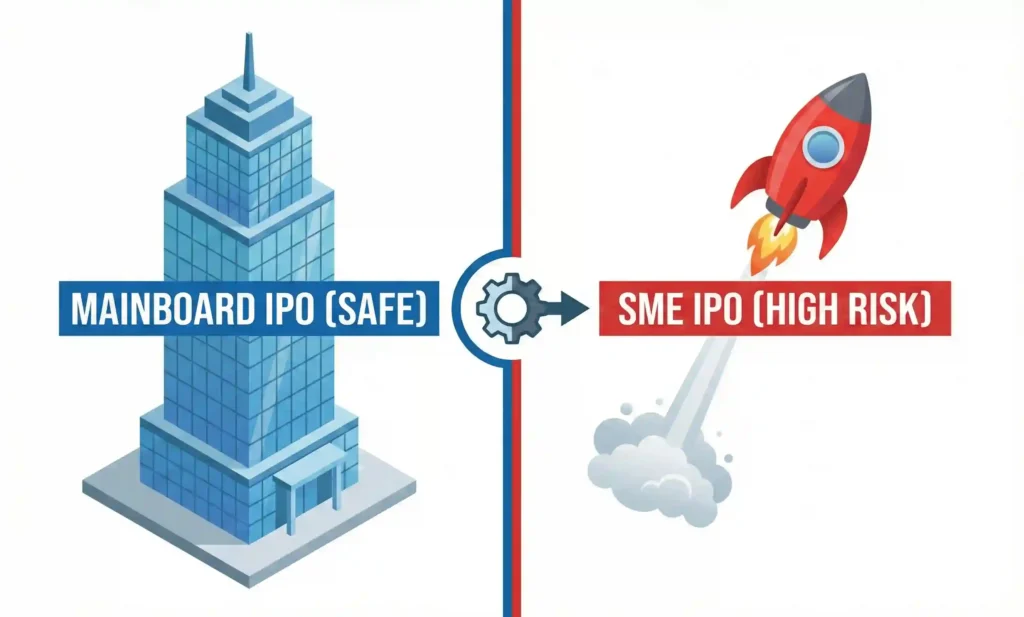
Before you invest, you must know the battlefield. The Indian market is split into two types of IPOs.
1. Mainboard IPOs:
These are large companies (like Hyundai or Swiggy).
- Min Investment: ₹15,000 (approx).
- Risk: Moderate.
- Liquidity: High (Easy to sell).
2. SME IPOs:
These are smaller companies listing on the SME exchange.
- Min Investment: ₹1,00,000+ (High barrier).
- Risk: High.
- Reward: Often list at 50-100% premium.
Deep Dive: If you are new, read our breakdown of the Initial Public Offering (IPO) Model to understand how book building and price bands work.
Step 2: The “Red Flag” Checklist (Copy-Paste)
Do not rely on news channels. Use this checklist before every application.
The Pre-Application Checklist:
- Promoter Holding: Is the promoter selling their entire stake? (If YES -> Avoid).
- Anchor Investors: Did top funds like SBI or HDFC buy in? (If YES -> Safe).
- GMP Trend: Is the premium rising or falling?
- Valuation: Is the P/E ratio lower than its peers?
Action: Check the real-time data on our Upcoming IPOs in 2026 calendar to run this test on new listings.

Step 3: My Market Analysis (Real Results)
I tracked several recent IPOs to see if the “GMP Strategy” actually works. Here is what I found in the current market cycle:
The “Green Energy” Boom
I noticed that any IPO related to renewable energy gets massive oversubscription.
- Result: The Waaree Energies IPO saw huge demand, confirming that sector sentiment beats financials in the short term.
- Watchlist: Keep an eye on the Bharat Coking Coal IPO as the next big energy play.
The “Niche” SME Winners
SME IPOs are where the aggressive gains are.
- Case A: The Shanti Gold IPO surged because of scarcity.
- Case B: Niche exporters like Biopol Chemicals and consumption plays like CKK Retail Mart are attracting smart money despite the high entry barrier.
- Case C: Wellness brands are also trending, as seen with Accretion Nutraveda.
The “Infrastructure” Stability
If you prefer safety, infrastructure remains king.
- Observation: The JSW Cement IPO and Tata Technologies IPO provided stable, predictable listing gains for long-term holders.
- Future Play: The upcoming NSDL IPO is the one to watch for 2026.
Step 4: Pros & Cons (Retail vs. sHNI)
Should you invest ₹15,000 (Retail) or ₹2,00,000+ (Small HNI)?
| Feature | Retail Category (<₹2L) | sHNI Category (₹2L – ₹10L) |
| Competition | Extremely High | Lower |
| Allotment Logic | Lottery System | Lottery (but higher probability) |
| Capital Blocked | Low | High |
| Ideal For | Beginners | Serious Investors |
Frequently Asked Questions
How do I check if I got the IPO?
Do not wait for the SMS. Visit the Registrar’s website directly. We have a full tutorial on How to Check IPO Allotment Status.
What is the “T+3” listing rule?
SEBI now mandates that shares must list within 3 working days of the issue closing. This frees up your capital faster.
Are SME IPOs safe for beginners?
No. They have low liquidity. You might buy a stock and find zero buyers when you try to sell. Stick to Mainboard IPOs initially.
Disclaimer: This article is for educational purposes only and does not constitute financial advice. IPO investments are subject to market risks. Please consult your financial advisor before investing.